Practical Tips I Wish I’d Been Given Earlier (As a Neurodivergent Person)
I would read articles like “10 simple habits to change your life” and feel instantly overwhelmed. The advice always seemed to assume a brain that could form habits easily, tolerate discomfort indefinitely, and function consistently every day. My brain does not work like that. These aren't life hacks. They’re things I’ve learned the hard way while living with neurodivergence in a world that rarely accommodates it.
1/7/20263 min read
Practical Tips I Wish I’d Been Given Earlier (As a Neurodivergent Person)
For a long time, I thought tips and advice just didn’t work for me.
I would read articles like “10 simple habits to change your life”
and feel instantly overwhelmed.
The advice always seemed to assume a brain that could form habits
easily, tolerate discomfort indefinitely, and function consistently
every day.
My brain does not work like that — and maybe yours doesn’t either.
So these aren’t “life hacks.”
They’re things I’ve learned the hard way while living with neurodivergence in a world that rarely accommodates it.
Take what helps. Leave what doesn’t.
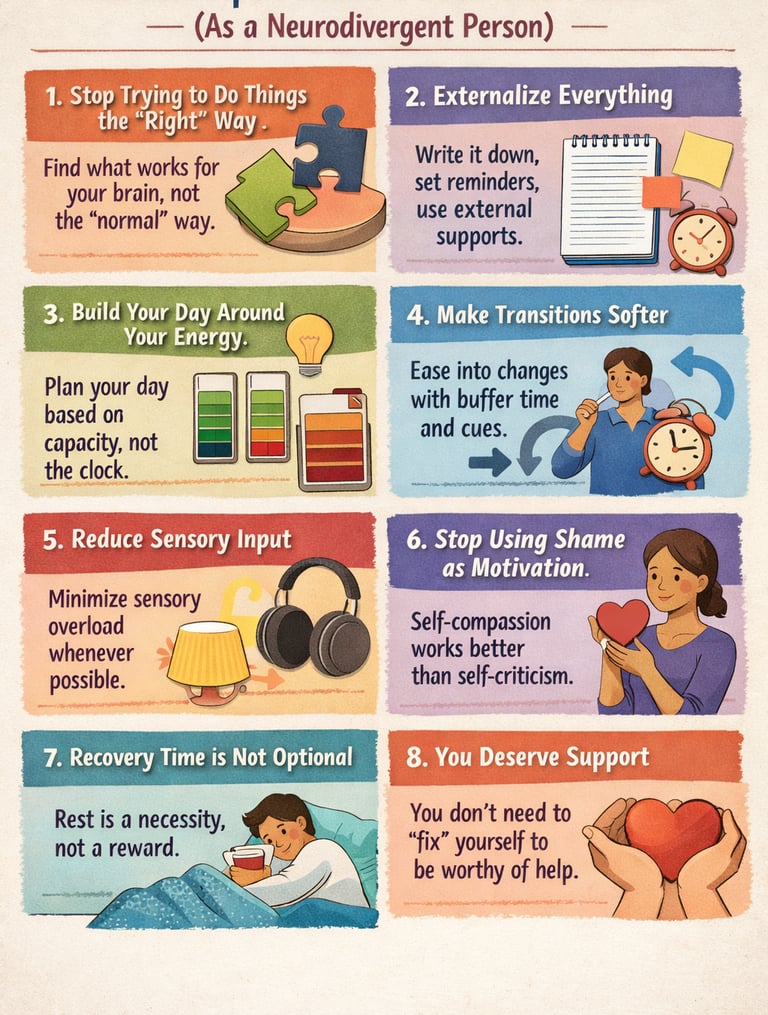
1. Stop trying to do things the “right” way
This was the hardest lesson for me.
For years, I forced myself to do tasks the way I thought they should be done — not the way that actually worked for my brain. I believed if I couldn’t follow the standard method, the problem was me.
It wasn’t.
If you need to shower sitting down, do it.
If you need to eat the same meal every day, do it.
If you need noise, silence, background shows, or complete darkness to function — that’s not failure, that’s customization.
Neurodivergent survival often looks “inefficient” from the outside. But efficiency means nothing if it costs you your mental health.
2. Externalize everything
My brain is not a reliable storage system — and once I accepted that, life became easier.
I write things down obsessively. Notes, reminders, lists, alarms, visual cues. Not because I’m disorganized, but because expecting my brain to remember everything creates unnecessary stress.
Some things that help:
Keeping one main “dump” note for thoughts and tasks
Using alarms not just for events, but for transitions
Writing things down immediately instead of “remembering later”
Externalizing information isn’t a weakness. It’s an accommodation.
3. Build your day around your energy, not the clock
One of the most damaging things I learned growing up was to ignore my own energy signals.
I now plan my day based on capacity, not time. Some days I can do one big thing. Some days I can do five small things. Some days rest is the task.
This means:
Doing demanding tasks when my brain is most alert
Accepting that productivity will look different day to day
Letting go of guilt when my energy crashes
You are not lazy for having fluctuating capacity. That’s part of neurodivergence.
4. Make transitions softer
Transitions are one of the most underestimated struggles for neurodivergent people.
Switching tasks, leaving the house, ending conversations — they all take more energy than people realize. I used to beat myself up for procrastinating, when in reality I was stuck in transition paralysis.
Things that help me:
Setting a “warning alarm” before needing to change tasks
Giving myself buffer time between activities
Narrating transitions out loud (“I’m finishing this, then standing up”)
Gentle transitions reduce burnout more than pushing through ever did.
5. Reduce sensory input where you can — on purpose
I spent years ignoring sensory needs because they felt “dramatic.”
They’re not.
Now I actively manage sensory input:
Comfortable clothes over fashionable ones
Earplugs or headphones without apology
Softer lighting whenever possible
Limiting background noise when I’m overwhelmed
You don’t need permission to make your environment tolerable.
6. Stop using shame as motivation
Shame never helped me function better — it only made me exhausted and afraid of failure.
If you’re only getting things done because you’re terrified of being judged, that’s not motivation. That’s survival mode.
When I replaced shame with curiosity, things slowly changed:
“Why is this hard?” instead of “What’s wrong with me?”
“What support do I need?” instead of “Why can’t I cope?”
Self-compassion is not indulgence. It’s regulation.
7. Recovery time is not optional
One of the biggest mistakes I made was treating rest as a reward instead of a requirement.
Socializing, masking, sensory overload, decision-making — it all costs energy. And if you don’t intentionally recover, burnout will force you to.
Recovery might look like:
Doing nothing without explaining yourself
Engaging in safe, repetitive comfort activities
Being alone without stimulation
Rest is not something you earn by being productive enough.
8. You don’t need to “fix” yourself to deserve support
This is the one I still have to remind myself of.
You don’t need to become more normal, more efficient, more resilient to deserve accommodations, understanding, or kindness. You don’t need to suffer quietly to prove anything.
Neurodivergence is not a personal failure. It’s a different operating system.
Living well with it doesn’t mean pushing yourself harder — it means listening earlier.
If you take nothing else from this post, let it be this:
You are allowed to make life easier for yourself.
That’s not giving up.
That’s learning how to live.